Uranüs’te bir günün ne kadar uzun sürdüğü, daha yüksek bir doğrulukla tespit edildi
Batuhan Sarıcan
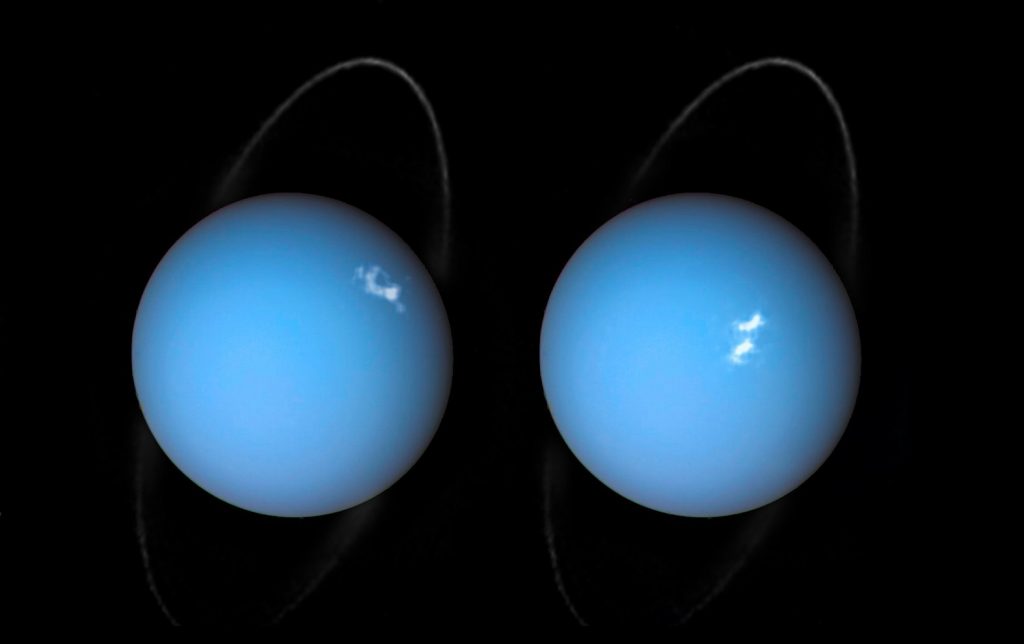
Ever since Voyager 2 beamed home spectacular images of the planets in the 1980s, planet-lovers have been hooked on extra-terrestrial aurorae. Aurorae are caused by streams of charged particles like electrons, that come from various origins such as solar winds, the planetary ionosphere, and moon volcanism. They become caught in powerful magnetic fields and are channelled into the upper atmosphere, where their interactions with gas particles, such as oxygen or nitrogen, set off spectacular bursts of light. The alien aurorae on Jupiter and Saturn are well-studied, but not much is known about the aurorae of the giant ice planet Uranus. In 2011, the NASA/ESA Hubble Space Telescope became the first Earth-based telescope to snap an image of the aurorae on Uranus. In 2012 and 2014 astronomers took a second look at the aurorae using the ultraviolet capabilities of the Space Telescope Imaging Spectrograph (STIS) installed on Hubble. They tracked the interplanetary shocks caused by two powerful bursts of solar wind travelling from the Sun to Uranus, then used Hubble to capture their effect on Uranus’ aurorae — and found themselves observing the most intense aurorae ever seen on the planet. By watching the aurorae over time, they collected the first direct evidence that these powerful shimmering regions rotate with the planet. They also re-discovered Uranus’ long-lost magnetic poles, which were lost shortly after their discovery by Voyager 2 in 1986 due to uncertainties in measurements and the featureless planet surface. This is a composite image of Uranus by Voyager 2 and two different observations made by Hubble — one for the ring and one for the aurorae.
Nature’da yayımlanan bir çalışma, Uranüs’te bir günün ne kadar uzun sürdüğünü daha yüksek bir doğrulukla ortaya çıkardı.
Çalışmanın yazarları, gezegenin dönüş periyodu hakkında “daha güvenilir tahminler” elde etmek amacıyla 2011 ve 2022 yılları arasında yapılan altı Hubble Uzay Teleskobu (HUT) gözlemine bakarak Uranüs’ün manyetik kutuplarındaki auroraların hareketini izledi.
Araştırmacılar, bu yaklaşımla elde edilen verileri, Uranüs’ün dönüş periyodu hakkında daha doğru bir tahmin yapmak için kullandı.
Daha önce tespit edilenden biraz daha uzun
Hubble’ın 11 yıllık gözlem geçmişine dayanan bu analiz, Uranüs’ün bir gününün 17 saat, 14 dakika ve 52 saniye sürdüğünü ortaya koydu.
Bu, NASA’nın Voyager 2 uzay aracının 1986’da Uranüs’ün yanından geçerken tespit ettiğinden “28 saniye daha uzun” bir süreydi.
Voyager 2, bundan yaklaşık 40 yıl önce, Uranüs’ü yakından gözlemleyen ilk uzay aracı olmuş, o dönemde gökbilimciler, gezegenin auroralarından gelen radyo sinyallerini ve uzay aracı tarafından toplanan manyetik alan verilerini kullanarak, Uranüs’ün bir gününün yaklaşık 17 saat, 14 dakika ve 24 saniye sürdüğünü bulmuştu.
Çalışmanın yazarı olan Paris Gözlemevi’nden gökbilimci Laurent Lamy, “Bu yeni boylam sistemiyle, yaklaşık 40 yıla yayılan aurora gözlemlerini karşılaştırabilir ve hatta yaklaşan Uranüs görevi için plan yapabiliriz,” ifadelerini kullandı.